Our Publications
Filter by category
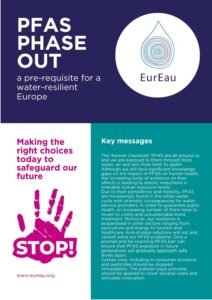
EurEau | PFAS phase out a pre-requisite for a water resilient Europe
In our paper – PFAS Phase Out: A Prerequisite for a Water Resilient Europe – we highlight the continued threat that PFAS pose to human health and the environment. We urge the European Commission to act now to ban these toxic chemicals.
Known as ‘forever chemicals,’ PFAS are present in our food, air, water and everyday products. Their persistence, mobility, and toxicity create far-reaching challenges for Europe’s water services.
Hodnota vodohospodářských služeb
Naši poskytovatelé vodohospodářských služeb dodávají ve dne i v noci. Pokaždé, když potřebujete nezávadnou a čistou vodu z kohoutku k pití, hygieně a sanitaci, stačí otevřít kohoutek.
Ti samí poskytovatelé služeb odvádějí použitou vodu mimo naše domovy a podniky, aby ji ošetřili, než se vrátí do životního prostředí, recyklují cenné živiny po cestě a pomáhají nám udržovat zdraví.
Tato privilegia jsou až příliš často považována za samozřejmost. Pochopení hodnoty našich vodohospodářských služeb znamená investování do naší budoucnosti a budoucnosti dalších generací. Voda nám dává život. Povědomí o hodnotě vodohospodářských služeb zajistí, že budou účinné, efektivní, odolné, udržitelné a dostupné pro všechny.
Hodnota sanitárních služeb
Chráníme naše vodní zdroje
Naši poskytovatelé vodohospodářských služeb dodávají ve dne i v noci. Pokaždé, když potřebujete nezávadnou a čistou vodu z kohoutku k pití, hygieně a sanitaci, stačí otevřít kohoutek.
Ti samí poskytovatelé služeb odvádějí použitou vodu mimo naše domovy a podniky, aby ji ošetřili, než se vrátí do životního prostředí, recyklují cenné živiny po cestě a pomáhají nám udržovat zdraví.
Tato privilegia jsou až příliš často považována za samozřejmost. Pochopení hodnoty našich vodohospodářských služeb znamená investování do naší budoucnosti a budoucnosti dalších generací. Voda nám dává život. Povědomí o hodnotě vodohospodářských služeb zajistí, že budou účinné, efektivní, odolné, udržitelné a dostupné pro všechny.
Public consultation on the Textile Labelling Regulation
This consultation relates to textile and related products, meaning leather products, apparel and clothingÂÂ accessories (even if made of other materials, such as leather or fur) as well as textile, leather and/or furÂÂ interior/household products, except for footwear products (which are governed by Directive 94/11/EC and
the review of which is not currently planned).
Ambitions of the water sector – Enabling factors
Our water services of tomorrow – Let’s make change happen
The water services sector has the ambition to play a front-running role in Europe’s journey to building climate-neutral, circular, smart and resilient society. To achieve this, water services will work with local and EU level policy makers to maximise the latest innovative technologies and practices, by digitalising their operations, exploiting their full energy efficiency and renewable energy generation potentials, and recovering nutrients and materials from waste water streams and drinking water treatment.
These are the five success factors we must achieve to set the sector on the path to change. They are accompanied by short check-lists for regulators and policy makers.
1. Enabling regulatory framework
2. Ensuring long-term funding and resources
3. Attracting a competent workforce and obtaining societal recognition
4. Developing innovative solutions and increasing motivation to change
5. Avoiding pollution at the source.
EurEau’s Water Resilience Strategy for Europe; Our vision for our water’s future
Our society, economy, environment and health depend on each of us having access to reliable, clean and affordable water every day. Your European water services strive every day to do this.
Much EU legislation to better protect people and the planet has been passed or is being processed since the last European Parliament elections – the Drinking Water Directive, the Urban Waste Water Treatment Directive, and legislation covering agriculture, chemicals and pharmaceuticals. One other cornerstone of water legislation – the Water Framework Directive – will need to define its post 2027 ambitions, and policy makers must decide whether to extend its reach to protect water resources. We support such a move.
We need a robust 360° strategy at European level to ensure that water services are protected across all areas. In our vision for our water’s future, we call on EU to prioritise:
-
Giving water its right place
-
Protecting the quality of our water resources
-
Addressing climate change
-
Enhancing the Circular Economy
-
Financing change while keeping water services affordable
-
Improving security and resilience and guaranteeing the protection of sensitive information.
Read more in our Water Resilience Strategy for Europe; Our vision for our water’s future.
Water sector research and innovation priorities 2023 update
Our world is changing rapidly and so are water services. Innovation is key to guaranteeing the affordability of safe, sustainable and resilient water services for the decades to come. Water service providers are well aware of the challenges and have identified a number of technological and non-technological areas requiring particular innovation efforts with a view to meeting the goals of the European Green Deal. New challenges have also placed a particular focus on the need for innovation across the sector’s supply chain to boost resilience as well as sustainability.
The research needs are compiled in this document and should help policy makers in designing research and innovation programmes in a way that responds to the real needs of drinking water and wastewater operators.
Public consultation on the Polluter Pays Principle
The polluter pays principle (PPP) should be implemented in EU environmental policies, as set out in Article 191(2) of the Consolidated Version of the Treaty on the Functioning of the European Union EUR-Lex - 12008E191 – EN (europa.eu).
Public consultation on the PPP- input additonal reading
Additional information is here
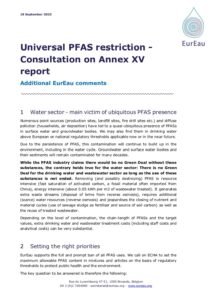
EurEau accompanying document to public consultation on UPFAS
Numerous point sources (production sites, landfill sites, fire drill sites etc.) and diffuse pollution (households, air deposition) have led to a quasi-ubiquitous presence of PFASs in surface water and groundwater bodies. We may also find them in drinking water above European or national regulatory thresholds applicable now or in the near future.