Our Publications
Filter by category
Public consultation to the Critical raw materials act
Critical raw materials are key to the green and digital transitions as well as to other EU priorities such as EU resilience and security. They are essential components of green technologies, are used in digital applications, and are crucial to the defence, aerospace and health industries. To secure a sustainable supply, the European Commission has had in place a dedicated strategy since 2008 and put forward an action plan in the 2020 Communication on Critical Raw Materials. Although the action plan is on track, the current context of growing global demand and increasing geopolitical instability creates the need for increased efforts.
EurEau comments on EFSA/ECHA Guidance on the impacts of water treatment processes on residues of active substances
EurEau welcomes this Guidance document on the impact of water treatment processes on residues of active substances, enshrining the European Commission’s efforts to protect human health and the environment. The document outlines which environmental water residues have to be assessed, the identification of water treatment transformation products that are formed, and how to complete a risk assessment that includes the consumption of treated drinking water.
Public consultation on the Soil Health Directive
The EU Soil Strategy for 2030 ‘Reaping the benefits of healthy soils for people, food, nature and climate’ envisages that all soils in the EU should be in a healthy condition by 2050 and that the protection, sustainable use and restoration of soil should become the norm. The Strategy announces that the Commission will table a new legislative proposal on soil health to ensure the same level of protection to soil that exists for water, the marine environment and air in the EU. Such a legislative initiative will be based on an impact assessment, including a subsidiarity check, and fully respect the better regulation requirements and the competences of Member States.
EurEau Feedback on the Commission draft delegated regulation amending the Classification, Labelling and Packaging of Chemicals
EurEau welcomes the introduction of new hazard classes in the CLP regulation (ED, PBT, vPvB, PMT and vPvM). The criteria for Mobility does not follow the UBA scientific opinion and we ask for more ambitious criteria on Mobility.
The CLP Regulation ensures that the hazards presented by chemicals are clearly communicated to workers and consumers in the European Union through classification and labelling of chemicals.
Contribution to the EU survey on possible future development of the FPR
The purpose of this survey is to collect proposals to adapt the annexes of the Fertilising ProductsThe purpose of this survey is to collect proposals to adapt the annexes of the Fertilising ProductsRegulation (EU) 2019/1009 (‘FPR’) to technical progress. In accordance with Article 42 FPR, the Commission is empowered to adopt delegated acts.
You can read our table on the potential future of the CMC
pdf
here
(157 KB)
.
EurEau response to the Consultation on the Nutrients Action plan for better management
Nutrients are chemical compounds that are essential for life. The most common nutrients include nitrogen (N) and phosphorus (P). Nutrients are found in soil, air and water, in agricultural fertilisers, in the food we consume and throw away as well as the sewage we produce. Human activities have significantly altered the natural processes which continuously cycle nitrogen and phosphorous in various (chemical) forms between different compartments of the environment. We consequently observe nutrient pollution that significantly affects public health, climate and the environment and at levels that exceed safe planetary boundaries. Nutrient pollution also has important economic consequences and puts at risk the sustainability of agriculture and fisheries in the EU.
EurEau response to the ELD public consultation
The Environmental Liability Directive (ELD) established a framework of environmental liability based on the ‘polluter pays’ principle, to prevent and remedy damage to land, water (surface, ground, transitional, coastal and marine waters), and biodiversity (species and natural habitats protected by the Birds and Habitats Directives).
Making operators financially liable for preventing and remedying environmental damage is intended to induce them to develop practices that minimise the risk that their activities will cause such damage.
In 2016, the European Commission published the first evaluation of the ELD. The Commission is now carrying out the second such evaluation. The evaluation will examine the effectiveness, efficiency, relevance, coherence and EU added-value of the ELD.
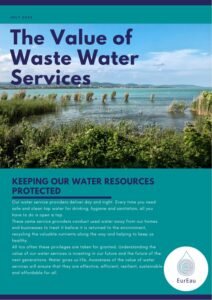
The Value of Sanitation Services
Our water service providers deliver day and night. Every time you need safe and clean tap water for drinking, hygiene and sanitation, all you have to do is open a tap.
These same service providers conduct used water away from our homes and businesses to treat it before it is returned to the environment, recycling the valuable nutrients along the way and helping to keep us healthy.
All too often these privileges are taken for granted. Understanding the value of our water services is investing in our future and the future of the next generations. Water gives us life. Awareness of the value of water services will ensure that they are effective, efficient, resilient, sustainable and affordable for all.
EurEau reaction to the public consultation on Sustainable food system – setting up an EU framework
In the context of the ‘‘European Green Deal”, the European Commission adopted a comprehensive Farm to Fork Strategy[1], which recognises the inextricable links between healthy people, healthy societies and a healthy planet and aims to address comprehensively the challenges of sustainable food systems.
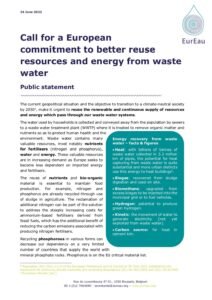
Public statement – Call for a European commitment to better utilise resources and energy from waste water
The current geopolitical situation and the objective to transition to a climate-neutral society by 2050, make it urgent to reuse the renewable and continuous supply of resources and energy which pass through our waste water systems. Waste water contains many valuable resources, most notably nutrients for fertilisers (nitrogen and phosphorus), water and energy. These valuable resources can be recovered and reused, making a significant contribution to the circular economy.