Our Publications
EurEau position on the Food and Feed Omnibus
The Commission proposal for the ‘Simplification and strengthening of food and feed safety requirements’ modifies the conditions for placing pesticides and biocides on the market It contains welcome measures to accelerate access to the market for new biocontrol substances and products.
However, several proposals will negatively affect compliance with article 7.3 of the Water Framework Directive and the requirements of the Drinking Water Directive, such as unlimited approval period of most active substances. Furthermore, it must be possible to ban pesticide uses easily and promptly as soon as monitoring data show that the environmental quality objectives of the Water Framework Directive are at risk from these substances. We call on the co-legislators to ensure the full protection of drinking water resources and avoid legal uncertainty between Regulation 1107/2009 and the DWD.
EurEau Recommendations on the Revision of the Water Framework Directive (WFD)
Protecting our drinking water resources in a changing geopolitical climate
EurEau position on the revision of the INSPIRE Directive
The INSPIRE Directive must be consistent with EU legislation aimed at protecting critical entities and vital societal services. The protection of public health and the environment must prevail over the right to access certain spatial data. Member States should be required to ensure that spatial data of infrastructure managed by the sectors listed in the annex to Directive 2022/2557 should not be made publically accessible, unless it are not security-relevant.
The limitation only applies to spatial data and not to environmental data.
EurEau position on the proposal for a regulation on the National and Regional Partnership Plans (next MFF)
Drinking water and wastewater services are essential to the functioning of Europe’s societies and its internal market. As the European Union prepares the next Multiannual Financial Framework, funding for cohesion, prosperity and security represents a key opportunity to strengthen the resilience, sustainability and climate neutrality of the water services sector, in line with the objectives of the European Water Resilience Strategy.
EurEau welcomes the Commission’s proposal for the National and Regional Partnership (NRP) Regulation and sets out targeted recommendations to ensure that water services infrastructure is adequately supported in the next seven-year financing cycle. These recommendations focus on securing explicit eligibility for water services infrastructure, mainstreaming funding across climate, environmental and security objectives, strengthening governance through the involvement of water service providers, and improving the sector’s capacity to absorb available funding.
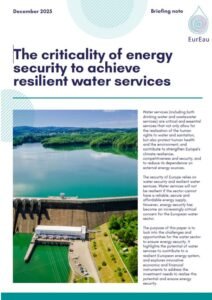
EurEau Briefing Note – The criticality of energy security to achieve resilient water services
Water services, including drinking water and wastewater, are essential to human rights, public health, environmental protection, and Europe’s climate resilience, competitiveness, and security. Europe’s overall security depends on water security, which in turn relies on resilient water services. Such resilience cannot be achieved without access to reliable, secure, and affordable energy. As energy security has become an increasing concern for the European water sector, this paper examines the key challenges and opportunities involved. It explores how water services can contribute to a more resilient European energy system and assesses innovative economic and financial instruments needed to meet investment requirements and strengthen long-term energy security.

Joint letter EurEau, Copa-Cogeca, IFOAM to Pres von der Leyen on EPR in UWWTD
We strongly believe that the rUWWTD is a crucial tool for improving Europe’s water quality, protecting aquatic biodiversity and public health. Its EPR scheme is a proportionate instrument to encourage sustainable market practices and pollution reduction whilst spreading the cost of pollution equitably and protecting the European food value chain.
Joint letter: Environmental omnibus
Water is vital for Europe’s future as Europe’s prosperity depends on water and only a stable regulatory environment can safeguard our progress.
Letter: Commissioner Roswall on the Food and Feed Omnibus
The Water Resilience Strategy’s call for better implementation of existing legislation must also include the rules regarding pesticide authorisation in order to protect public health. Simplifying the agricultural acquis must not be at the expense of resilient water services.
Letter – Tracking of Substance of Concern is vital for product sustainability and EU competitiveness
This joint statement by 42 organisations calls on EU policymakers to ensure chemical transparency and traceability in products as part of the transition to a clean and circular economy. It highlights the risks of hazardous substances to recycling, water services, public health, and competitiveness, urging strong implementation of existing strategies and regulations.
Wastewater treatment: Who pays the bill for cleaning up micropollutants
This paper examines the financing of micropollutant removal under the EU’s recast Urban Wastewater Treatment Directive (UWWTD), which introduces an Extended Producer Responsibility (EPR) scheme. Since pharmaceuticals and cosmetics are identified as major sources of micropollutants in urban wastewater, their producers will be required to cover at least 80% of the associated treatment costs. The paper highlights that this approach reflects the polluter-pays principle, helps protect water affordability for citizens, and ensures that both EU and non-EU producers contribute equally to the cost burden.