Our Publications
EurEau Position on the Regulation Preventing Plastic Pellet Losses
EurEau welcomes and strongly supports the European Commission’s Proposal for a Regulation on preventing plastic pellet losses to reduce microplastic pollution, which will allow for a regulatory framework implementing control at source for a relevant part of microplastics unintentionally released to the environment, and it will contribute not only to protecting water resources but also to meeting the objectives of the European Green Deal, the Zero Pollution Action Plan, as well as the New Action Plan on The Circular Economy.
EurEau Position on Dental Amalgam and the Mercury Regulation
EurEau welcomes and strongly supports the European Commission’s Proposal to amend the Mercury Regulation, banning the use, manufacture and export on dental amalgam from 2025, which will not only contribute to a long-term reduction of mercury in water bodies but also to the circular economy by allowing for a decrease of mercury in treated urban wastewater for reuse in agricultural irrigation and in sludge from wastewater treatment.
Ambitions of the water sector – Enabling factors
Our water services of tomorrow – Let’s make change happen
The water services sector has the ambition to play a front-running role in Europe’s journey to building climate-neutral, circular, smart and resilient society. To achieve this, water services will work with local and EU level policy makers to maximise the latest innovative technologies and practices, by digitalising their operations, exploiting their full energy efficiency and renewable energy generation potentials, and recovering nutrients and materials from waste water streams and drinking water treatment.
These are the five success factors we must achieve to set the sector on the path to change. They are accompanied by short check-lists for regulators and policy makers.
1. Enabling regulatory framework
2. Ensuring long-term funding and resources
3. Attracting a competent workforce and obtaining societal recognition
4. Developing innovative solutions and increasing motivation to change
5. Avoiding pollution at the source.
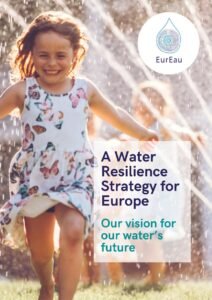
EurEau’s Water Resilience Strategy for Europe; Our vision for our water’s future
Our society, economy, environment and health depend on each of us having access to reliable, clean and affordable water every day. Your European water services strive every day to do this.
Much EU legislation to better protect people and the planet has been passed or is being processed since the last European Parliament elections – the Drinking Water Directive, the Urban Waste Water Treatment Directive, and legislation covering agriculture, chemicals and pharmaceuticals. One other cornerstone of water legislation – the Water Framework Directive – will need to define its post 2027 ambitions, and policy makers must decide whether to extend its reach to protect water resources. We support such a move.
We need a robust 360° strategy at European level to ensure that water services are protected across all areas. In our vision for our water’s future, we call on EU to prioritise:
-
Giving water its right place
-
Protecting the quality of our water resources
-
Addressing climate change
-
Enhancing the Circular Economy
-
Financing change while keeping water services affordable
-
Improving security and resilience and guaranteeing the protection of sensitive information.
Read more in our Water Resilience Strategy for Europe; Our vision for our water’s future.
Water sector research and innovation priorities 2023 update
Our world is changing rapidly and so are water services. Innovation is key to guaranteeing the affordability of safe, sustainable and resilient water services for the decades to come. Water service providers are well aware of the challenges and have identified a number of technological and non-technological areas requiring particular innovation efforts with a view to meeting the goals of the European Green Deal. New challenges have also placed a particular focus on the need for innovation across the sector’s supply chain to boost resilience as well as sustainability.
The research needs are compiled in this document and should help policy makers in designing research and innovation programmes in a way that responds to the real needs of drinking water and wastewater operators.
EurEau Position Paper on Soil Monitoring
While EurEau welcomes the Commission’s action to address the condition of soils, we regret the lower ambition shown by the proposed Directive on Soil Monitoring and Resilience compared to the abandoned project of a Soil Health Law. The monitoring rules laid down in the proposal are necessary but not sufficient. They should be accompanied by binding rules to protect and regenerate healthy soils. The Directive should incorporate stronger links with surface- and groundwater quality, as well as Circular Economy goals. Strong action for healthy soils is paramount for both drinking- and wastewater operators.
EurEau Position on Leakage Reporting
EurEau supports the Drinking Water Directive’s (DWD) goal of reducing water leakage, but emphasises the need for reliable data to underpin this effort. As the first step towards leakage reduction plans will involve calculating a Union average leakage rate, Member States must include the same index in their reporting. This index should be based on volumetric units so that all drinking water operators can easily implement it within the DWD timeframe.
EurEau position on the Detergents Regulation
The revision of this Regulation offers the possibility to adjust the requirements for detergents. In the view of drinking water and wastewater operators, the Commission’s proposal clearly lacks ambition and major environmental impacts are not sufficiently addressed.
The new Regulation should respond to the EU’s Zero Pollution ambition by strengthening the biodegradability requirements for all ingredients, including surfactants, avoiding the risk of microplastics generation, ensuring the safe use of microorganisms and reducing the release of phosphorous into the sewer network while strengthening phosphorous recycling.
EurEau Position Paper on the Pharmaceuticals Legislative Package
EurEau supports the Commission’s approach to promoting environmental protection coupled with access to medicines. While the proposal offers long-overdue advances in controlling pollution from pharmaceuticals at the source, it must go further in curbing excessive use of over-the-counter medicines, take into account risks posed by metabolites and transformation products, and provide further transparency for environmental risk assessments.
EurEau Position Paper Gigabit Infrastructure Act
On 23 February 2023, the European Commission presented its proposal for a Regulation for measures to reduce the cost of deploying gigabit electronic communications networks (gigabit infrastructure act, GIA). This proposal aims at facilitating the deployment of broadband infrastructure in line with the 2030 digital compass and the digital decade policy programme.
The expansion of high-performance networks for electronic communication is very important for the water sector. EurEau welcomes that drinking water infrastructure is exempt from the scope of the Regulation. The EU institutions should also take into account the special status of critical infrastructures when it comes to access to physical infrastructures and related data.