Our Publications
EurEau Annual Report 2022
2022 saw a welcome return to a more usual life after the COVID-19 pandemic of 2020-21. It was not without its challenges, however. The Russian invasion of Ukraine in February set off a chain of reactions that reverberated throughout the year, invoking energy-reduction and energy-efficiency measures to deal with the fallout. Also linked to it were supply chain disruptions, which impacted the delivery of essential chemicals necessary in water treatment processes.
Read about our work on these challenges and other issues affecting the water sector in our annual report for 2022.
EurEau Position Paper on Environmental Quality Standards
Directive 2022/0344 amends the Water Framework Directive (WFD) and its two daughter directives, the Groundwater Directive (GWD) and the Environmental Quality Standards Directive (EQSD).
The proposal adds pesticides, pharmaceuticals and PFAS to the priority substances lists for surface water and groundwater, and sets more flexible procedures to update Environmental Quality Standards (EQS).
EurEau welcomes the enlargement of the EQS lists as a prerequisite to providing safe and affordable drinking water services to consumers and as an effective means of protecting the environment.
If EQS are exceeded, the EU and Member States are obliged to take action to curb the emissions. EurEau requests that, in line with Article 191.2 of the Treaty on the Functioning of the European Union (TFEU), any exceedance of EQS should primarily trigger control-at-source measures.
EurEau Position Paper on the Proposal for a Directive concerning UWWTD
EurEau welcomes the European Commission’s Proposal for a Directive concerning urban wastewater treatment (recast) as its more ambitious objectives will align better with the overarching UN’s Sustainable Development Goals and the European Green Deal while enhancing the governance of the wastewater sector and people’s access to sanitation. Reaching the new goals and requirements as set out in the Proposal will require mainstreaming control at source, significant investments and time.
The purpose of this position paper is to identify the key topics within the Proposal which EurEau members see as the agenda to take forward through the
amendments process, aiming at enabling an effective and efficient implementation and achievement of the Proposal’s objectives.
Position Paper on the draft Industrial Emission Portal Regulation
EurEau supports major parts of the proposed Regulation, but calls for more clarity regarding ‘off-site transfer’ management. Easy access to data is paramount to facilitate the risk management of waste water operators.
Waste water treatment plants (WWTP) larger than 100,000 PE are covered by the Regulation as it was for the E-PRTR and the list of pollutants did not change. Some provisions are added regarding diffuse pollution, which is positive, but more details are needed in order for the Regulation to be correctly applied.
Position Paper on the Sustainable Use of Pesticides Regulation
We welcome the legislative proposal of the Regulation on the Sustainable Use of Plant Protection Products (SUR), enshrining the European Commission’s Zero Pollution ambition in pesticides policy to protect human health and the environment.
This legislative proposal heralds good news for water operators: water suppliers need water resources that are protected from pollution so that tap water remains safe and affordable, and the right to water is not jeopardised.
While the legislative proposal represents a major step in the right direction, we urge the European Parliament and the Council of the EU to embrace the change and support a European food system that protects water resources.
We regret, however, that Regulation (EC) No 1107/2009 on placing pesticides on the EU market will not be revised, since this legislation is key to restricting harmful pesticides. It must be ensured that only those substances that have no detrimental effects on human health, the environment, and more specifically, drinking water production, are allowed for use. This is not the case today. Furthermore, more attention should be paid to the possible combination effects of substances and regrettable substitutions of substances.
Position Paper on the Industrial Emission Directive
The proposed text meets most of the water service providers’ expectations by correcting some drawbacks of the current directive regarding the protection of water bodies. EurEau supports the general philosophy, aligned with the zero-pollution ambition, to control industrial pollution at the source. Overall, we find the Commission’s proposal goes in a very positive direction and we look forward to working with the EU institutions to make the IED an effective and robust force in protecting the environment, human health, water resources and water services’ workers.
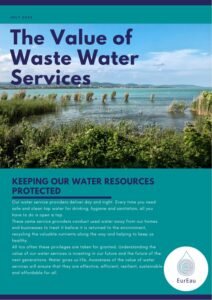
The Value of Sanitation Services
Our water service providers deliver day and night. Every time you need safe and clean tap water for drinking, hygiene and sanitation, all you have to do is open a tap.
These same service providers conduct used water away from our homes and businesses to treat it before it is returned to the environment, recycling the valuable nutrients along the way and helping to keep us healthy.
All too often these privileges are taken for granted. Understanding the value of our water services is investing in our future and the future of the next generations. Water gives us life. Awareness of the value of water services will ensure that they are effective, efficient, resilient, sustainable and affordable for all.
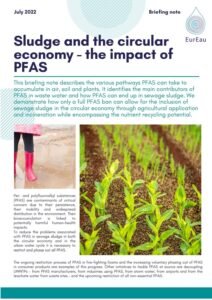
Briefing Note on Sludge and the circular economy – the impact of PFAS
This briefing note describes the various pathways PFAS can take to accumulate in air, soil and plants. It identifies the main contributors of PFAS in waste water and how PFAS can end up in sewage sludge. We demonstrate how only a full PFAS ban can allow for the inclusion of sewage sludge in the circular economy through agricultural application and incineration while encompassing the nutrient recycling potential.
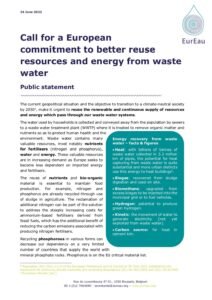
Public statement – Call for a European commitment to better utilise resources and energy from waste water
The current geopolitical situation and the objective to transition to a climate-neutral society by 2050, make it urgent to reuse the renewable and continuous supply of resources and energy which pass through our waste water systems. Waste water contains many valuable resources, most notably nutrients for fertilisers (nitrogen and phosphorus), water and energy. These valuable resources can be recovered and reused, making a significant contribution to the circular economy.
EurEau Annual Report 2021
It was another busy year for EurEau, with drinking water, PFAS, plastics, waste water, taxonomy and innovation high on our agenda. Read about our work in our annual report.