Our Publications
Open letter from 79 organisations on the EU reform of pesticides statistics 25.02.2022
Position paper on PFAS in the urban water cycle – Dec 2021 update
Removing PFAS from the urban water cycle causes a wide range of problems for water service providers. While technologies exist to remove most PFAS, they are unsustainable, mainly due to their technical complexity, resource intensity (water, energy, treatment chemicals etc.) and the generation of PFAS-containing residues. Reliance on end-of-pipe solutions creates a substantial stumbling block on the water sector’s journey towards climate neutrality. Any emissions of chemicals belonging to this group into the environment need to be avoided, using the Precautionary Principle and the Control-at-Source Principle. This can be best achieved by an EU-level ban of all PFAS uses.
Position paper on the Renewable Energy Directive
Although the Renewable Energy Directive (RED III) does not specifically address the water sector, the water cycle has renewable energy generation potential, i.e.: the generation of electricity from hydraulic turbines, biogas from sewage sludge, electricity and thermal energy from sewage sludge mono-incineration, electricity from on-site windmills and solar panels, heat pumps and thermal energy from waste water at several stages of the water cycle. Hence, the water sector substantially contributes to the renewable energy targets and climate policies.
Position paper on the Energy Efficiency Directive
EurEau supports the general objective of the Energy Efficiency Directive (EED) which is to promote energy efficiency next to using renewable energies with the overall goal to achieve energy and climate neutrality. The EED and the Renewable Energy Directive (RED) must accompany and support this process, taking into account the GHG emissions as the main indicator.
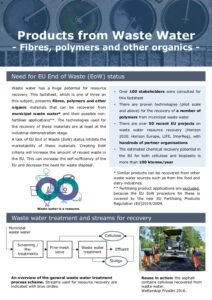
Factsheet on products from waste water – fibres and polymers
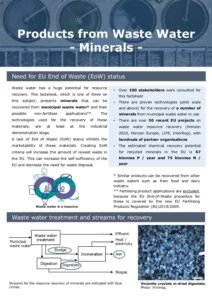
Factsheet on products from waste water – minerals
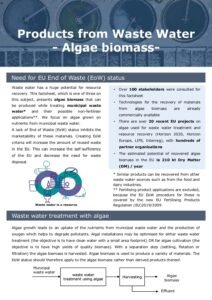
Factsheet on products from waste water – algae biomass
Position paper on Industrial waste water discharges into sewers
Waste water treatment plants (WWTP) remove pollutants from domestic waste water through mechanical and chemical processes and the biological activity of the biomass contained in the reactors. Chemicals coming from industrial waste water discharges into sewers can pose threats to waste water treatment, human health and the environment.
Therefore, controlling hazardous industrial discharges into sewers is an essential measure for protecting the environment, for the effective and sustainable operation of WWTPs, and to allow operators to comply with the Urban Waste Water Treatment Directive (UWWTD). Any sustainable policy framework must start from the Precautionary Principle, the Control at Source Principle and the Polluter Pays Principle, according to Article 191.2 of the Treaty on the Functioning of the European Union (TFEU).
Position paper on Environmental Quality Standards (EQS) for pharmaceuticals
EurEau supports the setting of Environmental Quality Standards (EQS) for pharmaceuticals provided several pre-conditions are met to avoid that the water sector will be the first and/or only stakeholder to take the burden for ensuring compliance.
EurEau expectations in the UWWTD revision process: public statement
European waste water service providers see the revision of the 1991 Urban Waste Water Treatment Directive (UWWTD) as an opportunity to develop an ambitious, innovative, supportive and straight-forward new policy framework enabling operators to meet the Green Deal goals and make waste water collection, treatment and management fit for the decades to come.