Our Publications
Position paper enabling the circular potential of sewage sludge
Enabling the circular economy for waste water services requires the alignment of a set of directives regulating the sector. The Urban Waste Water Treatment Directive (UWWTD), the Industrial Emission Directive (IED), the Waste Framework Directive (WFD) and the Sewage Sludge Directive (SSD) are key to the collection and treatment of urban waste water and subsequent treatment and re-use of urban waste water treatment sludge (UWWTS).
Position paper on the consideration of small agglomerations in the UWWTD
Small agglomerations have been identified as a source of pollution in the evaluation of the Urban Waste Water Treatment Directive (UWWTD). Despite that small agglomerations need to be better defined in the UWWTD, this source of pollution needs to be robustly addressed for the protection of biodiversity, ecosystems and for the protection of drinking water resources.
EurEau would like to see more guidance on monitoring and control of small or even individual systems at EU level through a thorough assessment and planning for the registration and monitoring of individual sanitation systems included in River Basin Management Plans. These elements should also be easily accessible to the local drinking water operators so that they can include them in the risk assessment and risk management of the catchment area as required in the recently recast Drinking Water Directive.
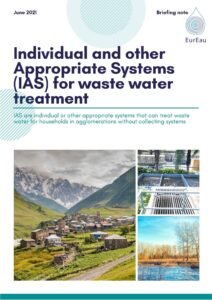
Briefing Note on IAS
Individual and other Appropriate Systems (IAS) are waste water treatment systems for one or a few households. They are authorised in certain circumstances under the Urban Waste Water Treatment Directive (UWWTD) and especially when it would be disproportionally expensive to build a sewer network to connect the waste water to a WWTP in a rural area. As the evaluation of the UWWTD revealed, IAS is one of the remaining sources of pollution in urban waters and often because of the lack of control and maintenance over them. However, with a variety of technical solutions, they offer an interesting alternative to municipal collection systems, especially with the European climate neutrality objective for 2050. In this briefing note, we explore how water-related legislation can be improved to ensure that IAS can continue to be part of the available solutions for sustainable waste water management.
Position paper on the Weser Ruling and its effects on UWWTP
This paper explains the technical and practical implications for Urban Waste Water Treatment Plants (UWWTP) regarding the legal problems triggered by the Weser Ruling. It suggests possible solutions to look forward.
Europe’s Water in Figures 2021
From morning until night and even while we sleep, our water operators are working 24 hours a day, and seven days a week, to deliver sustainable services that keep each of us safe and healthy.
The complex processes that we put in place to meet the challenges of delivering these services are adapted to their specific local circumstances. They depend on factors such as population density, the type and available quantity of water resources, required treatment levels, local topography and many other elements. Additional factors influencing prices, costs and asset values include the scope of the service, salary levels, taxes and the facility running costs.
We believe that our survey is the most comprehensive currently available. It includes national technical, economic and managerial data ranging from population connection rates to drinking water production to waste water treatment levels to prices and governance. The results testify to the diversity of the sector. They also show some of the immediate challenges our sector is facing, particularly regarding investment needs.
We trust you will find the information contained in this report useful.
Taxonomy Delegated Regulation on climate objectives
Statement on the Climate Action Technical Screening Criteria
Position paper on climate mitigation in the UWWTD
The European waste water sector can make a big contribution to reaching climate neutrality objective by reducing Greenhouse Gas emissions and energy consumption. The revision of the Urban Waste Water Treatment Directive can create momentum to build a legal framework to address climate mitigation and the impact of waste water treatment plants. This paper presents how a tailor-made approach could generate the most optimal results.
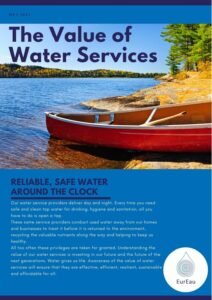
The Value of Water Services
Our water service providers deliver day and night. Every time you need safe and clean tap water for drinking, hygiene and sanitation, all you have to do is open a tap.
These same service providers conduct used water away from our homes and businesses to treat it before it is returned to the environment, recycling the valuable nutrients along the way and helping to keep us healthy.
All too often these privileges are taken for granted. Understanding the value of our water services is investing in our future and the future of the next generations. Water gives us life. Awareness of the value of water services will ensure that they are effective, efficient, resilient, sustainable and affordable for all.
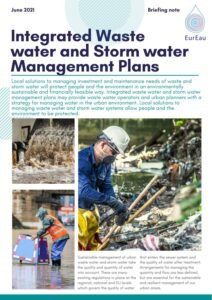
Briefing Note on Integrated Management Plans
Local solutions to managing investment and maintenance needs of waste and storm water will protect people and the environment in an environmentally sustainable and financially feasible way. Integrated waste water and storm water management plans may provide waste water operators and urban planners with a strategy for managing water in the urban environment. Local solutions to managing waste water and storm water systems allow people and the environment to be protected.
EurEau Annual Report 2020
What did EurEau get up to in 2020? Read on to find out, and what 2021 brings us!