Our Publications
EurEau response to NIS (Security of Network and Information Systems) review
The current directive is just being implemented, and so there is little or no experience as to how it functions in practice. Instead of revising, should the Commission focus on its effective implementation.
If the European legislators decide to proceed with the revision, they should focus on the further development of a coherent and streamlined regulatory framework for the security of network and information systems, without imposing additional and excessive burdens on industry.
At the same time, any duplication of legislation and inconsistencies with existing sector-specific and digital EU law should be avoided. The revision of the Directive should lead to a further strengthening of the preventive approach. This includes all aspects of detection and recovery by providing more and more detailed information on risks and incidents in the Member States, from national competent authorities to operators of essential services.
Briefing Note on nutrients and waste water management
This briefing note on nutrients and waste water management summarises how nutrients are currently managed within waste water and proposes ideas about the future of nutrient management within waste water management.
Position paper on the Precautionary and Innovation Principles
In the framework of new Commission policy work to protect public health and the environment, certain sectors, and in particular the chemical industry, are promoting a new ‘Innovation Principle’ next to the Precautionary Principle.
Position Paper on Best Available Techniques Reference Documents (BREFs)
EurEau strongly supports innovation in our sector. However, we do not agree that the approach of BREFs as defined under the Industrial Emissions Directive (IED) suits the context of the UWWTD. Innovation and affordability of water services are best supported by an UWWTD which establishes output requirements with clear indications of enhanced performance requirements to achieve specific protection of the environment and public health, rather than prescribed instruments.
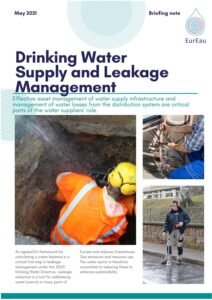
Briefing Note on Drinking Water Supply and Leakage Management
Effective asset management of water supply infrastructure and management of water losses from the distribution system are critical parts of the water suppliers’ role.
An agreed EU framework for calculating a water balance is a critical first step in leakage management under the 2020 Drinking Water Directive. Leakage reduction is a tool for addressing water scarcity in many parts of Europe, cuts Greenhouse Gas emissions and resource use. The water sector is committed to reducing these to enhance sustainability.
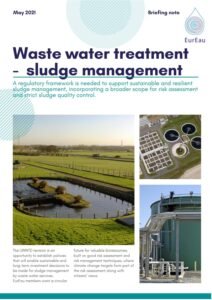
Briefing Note on sludge management
The current regulatory framework for sludge is set across a number of different instruments at EU level, which tend to focus on the waste dimension rather than on the reuse of the valuable resources. Waste water operators already render the valuable resources found in sludge to be reusable. However, a regulatory framework is needed to support sustainable and resilient sludge management, incorporating a broader scope for risk assessment and strict sludge quality control.
This briefing note details the current arrangement for the management of sludge that comes from waste water treatment. It will inform the reader of the existing solutions for sludge and gives a sound vision of the future and appropriate directions. It is based on EurEau members’ experience as waste water operators.
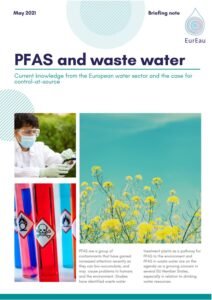
Briefing Note on PFAS and Waste Water
PFAS are a group of contaminants that have gained increased attention due to their potential to bio-accumulate, their environmental persistence, potential toxicity and, for many of them, high water solubility. They have been found in all environmental compartments, including wildlife and humans. Studies have identified waste water treatment plants as a pathway for PFAS to the environment. PFAS are a growing concern especially in relation to water resources used for the abstraction of drinking water.
Preventing PFAS from entering WWTP through control-at-source measures is the only way to avoid PFAS from being released to the (aquatic) environment through this pathway. A ban of all non-essential uses might be a first step. However, a coherent regulatory framework with clear instruments covering all persistent, mobile, toxic (PMT) and very persistent, very mobile (vPvM) substances needs to be in place to prevent and limit the emission of these substances to the water cycle.
EurEau expectations in UWWTD revision process: public statement
European waste water service providers see the revision of the 1991 Urban Waste Water Treatment Directive (UWWTD) as an opportunity to develop an ambitious, innovative, supportive and straight-forward new policy framework enabling operators to meet the Green Deal goals and make waste water collection, treatment and management fit for the decades to come.
New objectives to be delivered must consider the affordability of water services. This includes the long life-cycle of waste water collection and treatment assets and their inherent inflexibility for adaptation or upgrading.
The aim of this paper is to set our general expectations and point at areas to be covered by the impact assessment. Detailed positions or notes on specific topics will be delivered in due course.
Zero Pollution Action Plan – EurEau recommendations
Addressing the pollution of water resources in the context of the European Green Deal with its Zero Pollution Action Plan (ZPAP) is fundamental for the continued provision of safe and affordable drinking and waste water services, whose essential mission is to protect human health and the aquatic environment.
EurEau fully supports the zero pollution ambition and calls on the Commission to put water front and centre of the plan. Industry and agriculture have an important role to play in controlling pollution and rectifying environmental damage as much as possible at the source.
The action plan should propose concrete actions rather than focussing solely on establishing monitoring frameworks and promoting digital tools.
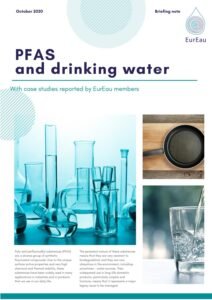
Briefing note on PFAS and drinking water
Poly-and perfluoroalkyl substances (PFAS) are a diverse group of synthetic fluorinated compounds. Due to the unique surface active properties and very high chemical and thermal stability, these substances have been widely used in many applications in industries and in products that we use in our daily life.
The persistent nature of these substances means that they are very resistant to biodegradation and they are now ubiquitous in the environment, including- sometimes – water sources. Their widespread use in long-life domestic products, particularly carpets and furniture, means that it represents a major legacy issue to be managed.