Our Publications
The Governance of Water Services in Europe – 2020 edition
Water services are essential services. They support the sustainable development of our societies and are fundamental to realising the ambition of the EU Green Deal and the UN Sustainable Development Goals, but little is known about them. This is because the infrastructure is mainly underground, accessible only to a few service engineers and also because it is sometimes situated far from urban areas and protected for obvious security reasons. But also because water services’ organisation differs from country to country due to history, cultural heritage and national or local traditions which result in specific regulatory frameworks.
Our report brings clarity and simplifies the governance of water services in Europe, and our report provides a snapshot of the current situation in the 29 EurEau member countries. It illustrates the diversity of management models, organisational structures, tasks and responsibilities of the players involved at the different levels of governance (EU, national, regional or local).
Briefing note on the impact of drought on drinking water
The availability of sufficient and uncontaminated ground- and/or surface water for the production of drinking water is essential to everyone.
The dry summer of 2018 (and for some countries, 2017 too) was a wake-up call for many parts of Europe. This is how drought affects drinking water, and how our sector and governance authorities can respond.
Innovating for a greener future: European water service priorities
Our world is changing rapidly and so are water services. Innovation is key to guaranteeing the affordability of safe, sustainable and resilient water services for the decades to come. Water service providers are well aware of the challenges and have identified a number of technological and non-technological areas requiring particular innovation efforts with a view to meeting the goals of the European Green Deal.
The research needs are laid out in this report and should help policy makers in designing research and innovation programmes in a way that responds to the real needs of drinking water and waste water operators.
EurEau Annual Review 2019
Water Framework Directive, Drinking Water, Reuse, microplastics, micropollutants, Extended Producer Responsibility; 2019 brought a lot of change and opportunity for the water sector. Our review of the year covers some of our work over the twelve months.
Briefing note on the management of the waste water and storm water networks
Our sewer networks are unseen arteries beneath our feet, carrying out the vital tasks of providing sanitation and drainage. They connect our homes, offices and industrial sites to waste water treatment plant. To ensure that those networks are fit for purpose today and into the long term, we need to plan, invest, operate and maintain them accordingly. And yet the nature of our sewer networks across Europe and the challenges they face are diverse, and the pressures they are under are evolving.
This document sets out what EurEau sees as sound, but sufficiently flexible management principles to meet this duality of need.
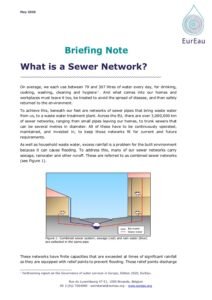
Briefing note on what is a sewer network
3 million kilometres of sewers spanning Europe transport the 79-307 litres of water each of us uses every day, for drinking, cooking, washing, cleaning and hygiene to a waste water treatment plant. Read more to find out how our sewers keep us safe and healthy.
Position paper on overflows from collecting systems
Sewer networks are a vital part of the urban environment. They provide drainage, prevent flooding of property and protect the water environment around urban areas.
We recognise many opportunities to make urban environments more sustainable through the management of waste water flows and storm water. We also acknowledge the significant financial responsibilities that are associated with making changes to the network of collecting systems.
EurEau comments on the Deloitte EPR study
This document provides a short reaction to and additional thoughts on the Deloitte study into Extended Producer Responsibility, accompanied by complementary information on the water services sector.
EurEau largely supports the study’s outcome. The study builds a solid case in favour of mandatory control-at-source measures, complemented, where necessary, by other mitigation measures along the supply chain and financed through mandatory EPR schemes. The study also highlights the need to adjust the relevant EU legislation, conduct a solid cost-benefit analysis of all mitigation measures and set up an inclusive process to develop fair, proportionate and effective EPR schemes
Briefing note on cooperation projects between water operators and farmers
Drinking water operators have a long history of cooperation with farmers with a view to reducing agricultural pressures on drinking water resources.
These cooperation projects encompass various activities: from advising and training farmers to paying minimum income guarantees in case of shifting to an alternative agriculture or even a financial transaction under the condition that pesticides and fertilisers are not applied in a given area.
Deloitte EurEau Report – Extended Producer Responsibility – Modules 1-2-3
EurEau commissioned a study to assess the potential applicability and relevance of extended producer responsibility (EPR) in order to develop clear policy guidance to address emissions of micropollutants and microplastics from products. A key finding of the study confirms that control-at-source measures should be the starting point of mitigation measures.